November 2026
Dragons—Fiction or Forgotten Friends?
Temas recientes
Dragons—Fiction or Forgotten Friends?
Septiembre y Octubre 2026
Seres místicos de la Tierra y del más allá
Julio 2026
Líneas Ley, Menhires & Monumentos
Mayo y Junio 2026
Nuestra Conexión con la Madre Tierra
Marzo & Abril de 2026
Portales
Febrero 2026
Líneas del tiempo
Diciembre de 2025 y Enero de 2026
Un Enfoque Espiritual para Afrontar los Retos de la Vida
Noviembre 2025
Atención e Intención
Octubre de 2025
Punto Cero y Equilibrio
Septiembre de 2025
El Yo Auténtico, el Ego y la Identidad
Julio de 2025
Trascender la División
Junio de 2025
Soberanía y Saliendo de la Matrix
“Me encanta realmente el tema espiritual de este mes. Me está ayudando mucho. Verdaderamente me ayuda a sanar.”
“Los temas espirituales fundamentales son tan conmovedores con nuestros nuevos miembros, muchos de los cuales están comenzando su viaje espiritual de despertar ... (Gracias Becky & Chris) ... La emoción de este despertar es tan maravilloso de ver.”
“Gracias al cielo por CC... a veces debo distanciarme de estas ilusiones para ver la paz.”
“Nuestros MST (Temas Espirituales del Mes) despojan a las personas de las máscaras que llevan para llegar a su verdadera identidad y enfrentarse cara a cara con lo que son: entonces pueden brillar su autenticidad, pero hace falta valor y mucho trabajo.”
“Empatía y compasión... es la segunda vez que este tema se explora en CC. Ver el crecimiento en mí mismo, en el equipo y en los miembros en su conjunto fue muy inspirador y confirmó que este es un trabajo hermoso e importante que todos estamos haciendo.”
“Estos vienen a mi como estar en el mundo de la conciencia social y autocorregir mi parte en él. Gracias por permitir estos cursos.”
“Estos temas me ayudan a centrarme en lo interno más que en lo externo. Es una distracción positiva del caos que nos rodea.”
“Ha sido tan interesante repetir los temas espirituales básicos. Queda muy claro cuánto han evolucionado la gente desde la primera ronda. Esta vez ha salido a relucir una vulnerabilidad, una reflexión y una profundidad increíble. Para reforzar aún más la vulnerabilidad y la reflexión, hemos creado una sección en la que las personas tienen la oportunidad de contar la historia de su vida si lo desean. ¿Cómo han llegado hasta aquí? ¿Qué retos han tenido? ¿Y cómo han crecido? Esto nos da la oportunidad de conocernos mejor, comprender mejor y mostrar compasión. A todos les encanta. Lo hacemos de dos en dos; parece una buena manera de predicar con el ejemplo.”
“Todos estamos en nuestro propio y único viaje. Todos estaremos muy desarrollados y avanzados en aspectos que otras personas no lo están, y tendremos áreas que aprender que otras personas pueden enseñaros o compartir con nosotros. Y creo que eso es maravilloso. Nunca te sientas menos que nadie.”
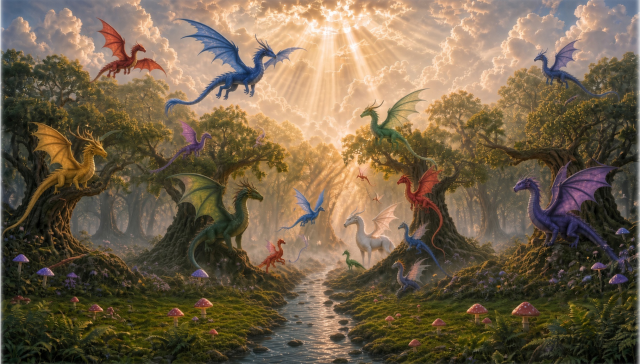
Let’s face it: Dragons have had a bad rap. In movies and books, they are typically the ‘bad guys’—fire-breathing, fierce, annihilating, and causing chaos and ruin. Even many children’s books portray dragons as flying in and slaying kingdoms. Unicorns have been written off as fictional creatures, often with a condescending statement like, “Do you think life is all sunshine, rainbows, and unicorns?”
It is socially acceptable for children to believe in dragons, fairies, unicorns, and other ‘mythical’ creatures; however, not so for adults. These beings have been relegated to myths and children’s stories where ‘imagination’ is allowed.
And yet, there are adults who hold on to their imagination, draw upon inspiration, and have a broader faith in both the seen and unseen.
“I believe in everything until it’s disproved. So I believe in fairies, the myths, dragons. It all exists, even if it’s in your mind. Who’s to say that dreams and nightmares aren’t as real as the here and now?”—John Lennon
“For fantasy is true, of course. It isn’t factual, but it is true. Children know that. Adults know it too, and that is precisely why many of them are afraid of fantasy. They know that its truth challenges, even threatens, all that is false, all that is phony, unnecessary, and trivial in the life they have let themselves be forced into living. They are afraid of dragons, because they are afraid of freedom.”—Ursula K. Le Guin, American speculative fiction author
There are many other ‘mythical’ beings, such as Mermaids, Griffins (a hybrid of a lion and an eagle), Phoenixes, Sphinxes, Chimeras, Loch Ness Monsters, and many more. There are also more human-like beings such as Fairies, Pixies, Elves, Gnomes, Leprechauns, Giants, Sasquatch, Centaurs (half-human, half-horse), Minotaurs (half-man, half-bull), Fauns (half-man, half-goat), and others that we reviewed in the last Monthly Spiritual Topic. For the rest of this topic, we will focus primarily on dragons.
El texto completo, así como recursos adicionales, están a disposición de los miembros de CC en Mighty Networks, la plataforma privada de CC.
¿Qué son los Temas Espirituales del Mes (MST)?
Cada mes creamos nuevos temas espirituales. Los coordinadores utilizan estos temas para facilitar los debates y dar a los miembros de la oportunidad de hablar sobre situaciones de la vida real y compartir perspectivas, ideas y estrategias. Los temas espirituales se publican en la plataforma de la red social interna de CC , donde miembros de todo el mundo entablan conversaciones y comparten pensamientos personales. Estos temas están diseñados para ofrecer puntos de debate sobre el autoconocimiento y el desarrollo espiritual que nos permitan y nos capaciten para convertirnos en la mejor versión de lo que somos.
Objetivos de los Temas Espirituales del Mes (MST)
Todos estamos en un viaje único para crecer y encontrar un mayor significado, propósito y alegría en la vida. Para ello es necesario centrarse en nuestro interior. Como dijo Rumi, poeta persa del siglo XIII: "Todo lo que hay en el universo está dentro de ti. Pídetelo todo a ti mismo".
Con este fin, los Temas Espirituales Mensuales (MST) están diseñados para ayudar a los miembros:
- =a conocerse mejor a sí mismos (autorrealización)
- a conectar con su sabiduría interior
- a desarrollar la concentración y la intención consciente
- a vivir desde un espacio centrado en el corazón
- a expresar compasión y estar al servicio de los demas
- a alinearse con su Yo Superior/Divino
- a manifestar un cambio positivo para sí mismos y para el colectivo
Objetivos de los MST
El proceso del Tema Espiritual Mensual se creó con dos objetivos principales: Ofrecer diálogo espiritual y educación a los miembros y proporcionar a los Coordinadores materiales sobre temas relevantes para facilitar debates interesantes entre los miembros. Esto ahorra tiempo a los Coordinadores que asi ya no necesitan buscar temas y encontrar materiales para presentar. También ofrece a los coordinadores la oportunidad de desarrollar aún más sus habilidades de facilitación.